Student Services : Tuition & Fees : Sitemap : Contact Us  
 
Why UC Santa Cruz?
Majors & Courses
 
Division of the Arts
Division of Humanities
Division of Physical and Biological Sciences
Division of Social Sciences
Jack Baskin School of Engineering
Publications
Housing
Sports & Recreation
FAQ
Parent Guide
 
 
UCSC General Catalog Site
Schedule of Classes Site
Academic and Administrative Calendar Site
 
[+] help and feedback
 
The Marine Biology Major
 

The marine biology major is designed to introduce students to marine ecosystems, including the great diversity of marine organisms and their coastal and oceanic environments. The emphasis is on basic principles that help us to understand the processes that shape life in marine environments. The marine biology major is a demanding program that offers a B.S. degree and requires several more courses than the general biology B.A. major.

Study and Research Opportunities

  • B.S.
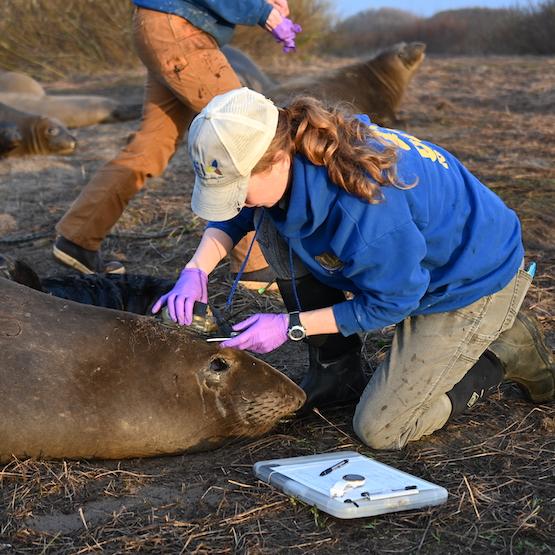
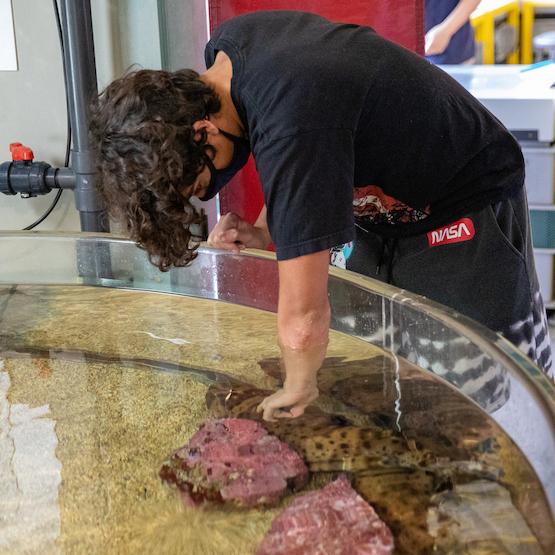
  • A large number and variety of field and laboratory courses that provide students with opportunities to conduct directed and independent research projects
  • An array of opportunities in the Monterey Bay area for directed faculty- and/or department-sponsored independent study in marine biology
MarineBio.pdf


  More Information
  Catalog Description

Biological Sciences site

Biological Sciences Advising
387 Thimann Laboratories
University of California, Santa Cruz
1156 High Street
Santa Cruz, California 95064
(831) 459-4143
bioadvise@biology.ucsc.edu

High School Preparation
In addition to the courses required for UC admission, high school students who intend to major in biology should take high school courses in biology, chemistry, and advanced mathematics (precalculus).

Transfer Preparation
The faculty encourage applications from transfer students in the biological sciences. Students and their college advisers are strongly recommended to examine the degree requirements for the student’s intended major. Students should satisfy as many introductory requirements as possible prior to transfer. Courses offered at the student’s institution should be compared to the UC Santa Cruz transfer agreements (found at www.assist.org) and/or course descriptions to ensure that they will qualify for transfer. It is very important for transfer students to complete science prerequisite courses before transfer, especially precalculus and general chemistry. Students should also take an introductory biology sequence, calculus, and if possible, organic chemistry. Prospective transfer students should contact the biology undergraduate advising office for further information. In addition, please see the Course Substitution/Transfer Credit section.

Introductory requirements for the marine biology major are:

• Biology 20A, Cell and Molecular Biology, 20B, Development and Physiology, and 20C, Ecology and Evolution

• Chemistry 1B/M and 1C/N, General Chemistry with Laboratory (two quarters)

• Applied Mathematics and Statistics 7/L, Biostatistics with Laboratory

• Mathematics 11A-B, Calculus with Applications (two quarters) or Mathematics 19A-B, Calculus for Science, Engineering, and Mathematics (two quarters)

• Physics 7A/L and 7B/M, Elementary Physics (two quarters)

Recognition
Terrie M. Williams, professor of ecology and evolutionary biology and the Ida Benson Lynn Professor of Ocean Health, is an expert on animal physiology and energetics who was recently named one of Discover magazine’s 50 top women scientists. Her research on dolphins includes ongoing work with the two resident dolphins at UC Santa Cruz’s Long Marine Laboratory.

Careers
Students with bachelors degrees in marine biology find employment opportunities in a variety of fields. In conjunction with a graduate degree in teaching, students often use their marine biology background to teach science at the K-12 level. Technical positions with local, state, and federal governmental agencies are most commonly pursued. Coastal cities and counties maintain biology staffs for monitoring and evaluating water quality and environmental impacts of marine discharges. Examples of employment opportunities with California’s state agencies include the State Water Resources Control Board and Regional Water Quality Control Boards, Environmental Protection Agency, Departments of Conservation, Fish and Game, Water Resources, and the California Coastal Commission (these and other applicable state agencies are listed at: resources.ca.gov). Examples of federal agencies include National Marine Fisheries Service, U.S. Fish and Wildlife, United States Geological Service’s Biological Resources Division, Environmental Protection Agency, National Marine Sanctuaries, National Ocean Service, National Park Service, and others. The number of local, regional, national, and international non-governmental organizations (NGO’s), especially those oriented toward marine conservation, continues to grow rapidly. These organizations hire students as interns and permanent technical staff.

Elsewhere in the private sector, students find employment with mariculture, environmental consulting, aquariums, and biotechnology firms. Academic research institutions also hire students for technical research positions. All of the above provide students opportunities to explore career trajectories as they consider continuing their education in graduate programs. The strong reputation of the marine biology program at UC Santa Cruz underpins the strong record of successful placement of its graduates in employment and graduate programs.

Course Substitution/Transfer Credit
At least half of the upper-division courses (Biology 100–190) required for each biological sciences major must be taken through the biological sciences program at UC Santa Cruz, not as transfer credits from another department or institution. Transfer students are advised to contact the Biological Sciences Undergraduate Advising Office before enrolling in numerous upper-division courses at other institutions.

Education Abroad Program (EAP)
The UC Education Abroad Program (EAP) offers qualified students unique opportunities to broaden their educational horizons. Many programs are in English-speaking countries or use English for advanced courses. Many programs offer small classes and extensive laboratory and/or field research experience.

There are excellent programs for biological science students in Costa Rica, Australia, New Zealand, the United Kingdom, Denmark, and Germany, among others. The Costa Rica Tropical Biology Program is of note to students interested in tropical biology and ecology. Held spring and fall quarters at the Monteverde Research Station, this program gives students experience with hands-on field research, offers a homestay program, and carries credit for upper-division biology courses. The University of Queensland (Australia) offers an intensive, full-semester Marine Science Program, which includes a stay at a research station on the Great Barrier Reef, near sheltered mangrove and seagrass habitats.

Students interested in study abroad need to get an early start on their basic science requirements, including general and organic chemistry, math, and introductory biology. Visit the EAP office as soon as possible to begin planning, and seek advice about your academic plan from the biological sciences undergraduate adviser and/or faculty adviser.

Academic Advising
Academic advising is available at the Biological Sciences Undergraduate Advising Office. Students should take full advantage of this opportunity and should keep in frequent touch with the office to stay informed about late announcements of courses, changes in scheduling, and opportunities for special study.

The advising office publishes the Biological Sciences Undergraduate Web Site, which contains substantial advice and information pertinent to students. Each student in the major should review the information posted on the web site; for further assistance, contact the advising office.