The Chemistry Major 2010-11

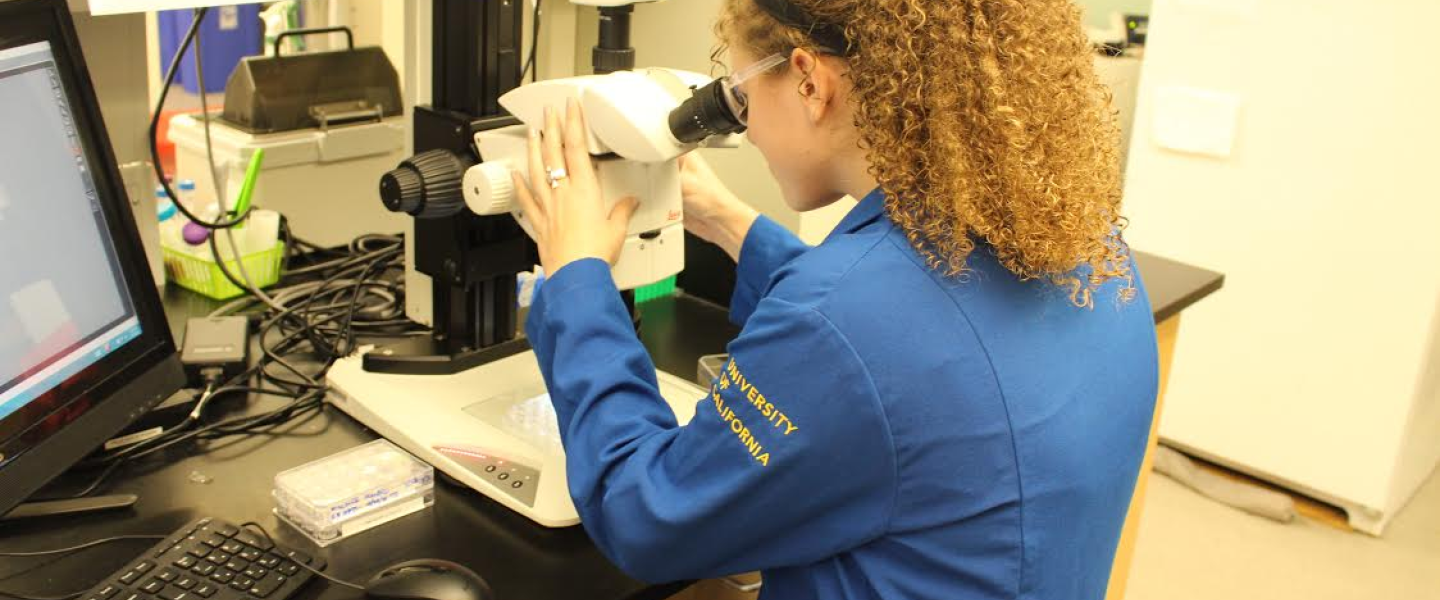
UCSC researchers are well known for their work on ribosomes.

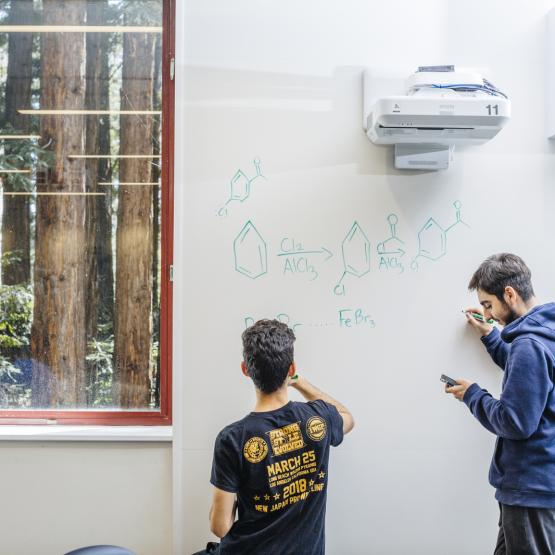
The curriculum in chemistry exposes students to the principal areas of modern chemistry, including organic, inorganic, physical, analytical, and biochemistry. Research in chemistry at UC Santa Cruz is closely interwoven with graduate and undergraduate education. The chemistry program is active at the graduate level, and the faculty also encourages undergraduates to become involved in research.

Study and Research Opportunities

  • B.A.; B.S. with concentrations in biochemistry and environmental chemistry; M.S.; Ph.D.; undergraduate minor
  • Several undergraduate research scholarships and scholarly meeting and conference travel awards are available to eligible chemistry students.

High School Preparation

Prospective chemistry majors are encouraged to get a solid foundation in high school mathematics; familiarity with algebra, logarithms, trigonometry, and analytic geometry is particularly recommended. Students who take chemistry at UC Santa Cruz will begin with either Chemistry 1A or Chemistry 1B. Both courses will require a solid background in high school chemistry, and it will be part of a rigorous sequence in which introductory college-level material is distributed among Chemistry 1A, 1B, and 1C.

Transfer Preparation

The Chemistry and Biochemistry Department encourages the admission of students from community colleges. Students who intend to transfer from other institutions, particularly community colleges, are urged to develop a strong background in general chemistry, organic chemistry, calculus, and physics. If the institution offers a physics course based on calculus as well as a non-calculus-based course, the student should take the calculus-based course. Prospective transfer students should consult with a community college advisor regarding details of course transferability, and soon after arrival at UC Santa Cruz they should meet with a Physical and Biological Sciences academic advisor in order to clarify their transfer credit status.

UC Santa Cruz introductory requirements for the B.A. degree in chemistry are:

  • Chemistry 1A, 1B/M, and 1C/N, General Chemistry with Laboratory (three quarters)
  • Chemistry 108A/L and 108B/M, Organic Chemistry with Laboratory (two quarters); or Chemistry 112A/L, 112B/M, 112C/N, Organic Chemistry with Laboratory (three quarters)
  • Mathematics 11A-B, Calculus with Applications (two quarters) with Mathematics 22, Introduction to Calculus of Several Variables; or Mathematics 19A-B, Calculus for Science, Engineering, and Mathematics (two quarters) with Mathematics 22, Introduction to Calculus of Several Variables
  • Physics 5A/L, 5B/M, and 5C/N, Introduction to Physics with Laboratory (three quarters) or Physics 6A/L, 6B/M, and 6C/N, Introductory Physics with Laboratory (three quarters)

UC Santa Cruz lower-division requirements for the B.S. degree in chemistry are:

  • Chemistry 1A, 1B/M, and 1C/N, General Chemistry with Laboratory (three quarters)
  • Chemistry 112A/L, 112B/M, 112C/N, Organic Chemistry with Laboratory (three quarters)
  • Mathematics 19A-B, Calculus for Science, Engineering, and Mathematics (two quarters) with Mathematics 22, Introduction to Calculus of Several Variables
  • Physics 5A/L, 5B/M, and 5C/N, Introduction to Physics with Laboratory (three quarters) or Physics 6A/L, 6B/M, and 6C/N, Introductory Physics with Laboratory (three quarters)

UC Santa Cruz introductory requirements for the B.S. degree with environmental chemistry concentration are:

  • Biology 20A, Cell and Molecular Biology and Biology 20B, Development and Physiology
  • Chemistry 1A, 1B/M, and 1C/N, General Chemistry with Laboratory (three quarters)
  • Chemistry 108A/L and 108B/M, Organic Chemistry with Laboratory (two quarters); or Chemistry 112A/L, 112B/M, 112C/N, Organic Chemistry with Laboratory (three quarters)
  • Earth Sciences 20/L, Environmental Geology with Laboratory, or Earth Sciences 10/L, Geologic Principles with Laboratory, or Earth Sciences 5/L, California Geology with Laboratory
  • Environmental Studies 25, Political Economy and the Environment
  • Mathematics 11A-B, Calculus with Applications (two quarters) with Mathematics 22, Introduction to Calculus of Several Variables; or Mathematics 19A-B, Calculus for Science, Engineering, and Mathematics (two quarters) with Mathematics 22, Introduction to Calculus of Several Variables
  • Physics 5A/L, 5B/M, and 5C/N, Introduction to Physics with Laboratory (three quarters) or Physics 6A/L, 6B/M, and 6C/N, Introductory Physics with Laboratory (three quarters)

While it is not a requirement for admission, students from California community colleges may complete the Intersegmental General Education Transfer Curriculum (IGETC). A completed and certified IGETC program satisfies the university’s general education requirements. To learn more about IGETC and its requirements, prospective transfer students should consult with their transfer center counselor.

However, students planning to major in the sciences and engineering are not well served by completing IGETC due to the extensive lower-division major preparation course load and related prerequisite course requirements. Students interested in these high-unit majors are encouraged to complete courses equivalent to the specific program’s lower-division major requirements first and the university’s broader general education equivalents second. Please see www.assist.org to identify these course equivalents.

Careers

  • Agricultural chemistry
  • Biochemistry
  • Chemical manufacturing
  • Chemical marketing
  • Chemical oceanography
  • Clinical chemistry
  • Drug control
  • Environmental chemistry
  • Food science
  • Health sciences
  • Medical technology
  • Medicine
  • Petrochemical technology
  • Pharmacology
  • Pollution control
  • Polymer chemistry
  • Teaching
  • Technical writing
  • Toxicology

These are only samples of the field’s many possibilities.

Recognition

Using bioassay-guided isolation, Chemistry and Biochemistry Professor Phillip Crews researches marine natural products with the goal of discovering natural products potent against human diseases such as cancer or viruses. His research has far-reaching implications in areas such as chemical ecology, marine natural products biosynthesis, and the relationship between secondary metabolite chemistry and taxonomy. The focus of Professor Jin Zhang’s research is on understanding and developing novel advanced materials such as semiconductor and metal nanoparticles for electro-optics and photomedicine.

American Chemical Society Certification

The American Chemical Society (ACS) recognizes certain undergraduate programs, including those of UC Santa Cruz, to be of such quality as to entitle graduates to become ACS members immediately upon graduation. Graduates must be individually certified to the ACS by the Chemistry and Biochemistry Department chair if they have satisfactorily completed an approved program of study. ACS certification standards are rigorous; a graduate who has met them carries a distinction that is well recognized in the profession. ACS certification requirements are satisfied by completing a B.S. major in chemistry (not including concentrations in biochemistry or environmental chemistry) at UC Santa Cruz, including course 122, Principles of Instrumental Analysis, as an elective. A year of study in a major modern foreign language (preferably German) is recommended. More information is available from the chemistry undergraduate adviser.

More Information

E-mail: chemistryadvising@ucsc.edu

Undergraduate Affairs
Physical and Biological Sciences
387 Thimann Labs
University of California, Santa Cruz
1156 High Street
Santa Cruz, California 95064
(831) 459-4143
undergrad.pbsci.ucsc.edu/

See Also